Seminars

Legal Pluralism, Decentralization and Conflict in the Sahel

Legal Pluralism, Decentralization and Conflict in the Sahel Gerti Hesseling  (University of

Mourning and Memory in Congo

Mourning and Memory in Congo Bogumil Jewsiewicki  (University of Laval, Quebec)

The Unreason of the Law

The Unreason of the Law Jean & John Comaroff University of Chicago

Household, Future-making and Debt

Presented by: 
Deborah and Caitlin
James and Zaloom
How does a household come to exist? What tools do its members use to draw some together and expel others? How do households articulate with the spheres of economy and politics and their forms of power and control?

The costs of foreign capital

Presented by: 
Leigh
Gardner
Formal recognition of Liberia's sovereignty offered the government the opportunity to borrow on international markets that were growing rapidly during the second half of the nineteenth century.

WiSER in 2018

WiSER in 2018


Debt and Financial Inclusion in Kenya: Digital Lending and Co-operative Societies

Presented by: 
Eric
Magale
Co-operatives have long been important institutions for low- to middle-income Kenyans, long before the financial inclusion discourse came about.

Zotero Workshop : 29 August 2018

The basics for this Zotero workshop are available here:  https://wiser.wits.ac.za/event/zotero-workshop-basics.

Wits Institute for Social and Economic Research researchers reflect on the rich history and character of Johannesburg

Summary: Wits Institute for Social and Economic Research researchers reflect on the rich history and character of Johannesburg

By Edward Tsumele | CityLife Arts | 20 October 2026 | Link to Original Article

(Self-)purchase, obligation and the financial lives of enslaved and manumitted people in nineteenth-century Cape Town

Presented by: 
Kate
Ekama
This paper uses manumission as a lens through which to explore the financial lives of enslaved people in nineteenth-century Cape Town. Between 1825 and 1834, more than one thousand two hundred people were manumitted in the city, about a third of whom achieved that through (self-)purchase.

Balancing Competing Obligations: Sovereign Debt, the African Human Rights System, and the Pursuit of a Rights-Based Approach to African Debt

Presented by: 
Danny and Magalie
Bradlow and Masamba
Africa's sovereign debt crisis is exacerbating human rights vulnerabilities, yet the African human rights systems and institutions have remained largely absent from debt governance debates.

A Tale of Two Payment Systems: Debt and the Social Welfare State

Presented by: 
Erin
Torkelson
Over the past decade and a half the South African social grant payment system has changed several times -- but, debt has been part and parcel of each new system.

Networks, Institutions and the Failure of the Survey Law of 1874 in the Transvaal

Presented by: 
Lyndsey Frederick
Braun
This article concerns the birth and death of the proposed Survey Law of 1874 in the South African Republic (Transvaal), a law that promised to 'correct' flawed or fraudulent knowledge with an ongoing triangulation and a general survey of lands that would locate and map all aspects of geography for t

Everyday strategies of debt resistance: the case of fintech in Nigeria

Presented by: 
Shuaib
Jalal-Eddeen
This article examines the resistance strategies employed by fintech users in Jimeta, Nigeria against the violent techniques used by fintech companies to enforce loan repayments.

Digital Identity and Data Privacy in Africa : Research Notes and Links

https://wiser.wits.ac.za/ResearchingDigID

Tools for researching Digital Identity on the African Continent

Use a documentary database management tool – Zotero https://www.zotero.org (keeping track of the changing web, sharing)

* Good summary overview : Gelb and Metz Identification Revolution

WISER Director's position on Tangwa Seminar

Wiser has received numerous calls and inquiries concerning the recently announced seminar in the Mapping African Futures seminar series.  As Director of WISER I would like to dissociate both myself and this Institute from the problematic and objectionable assertions in the proposed seminar by Professor Tangwa on the subject of  gender.   I was not consulted on the announcement of the talk.

The Trust Seminar

Many countries on the African continent are building powerful new biometric population registration systems. Often matched with credit scoring regulations and digital payment systems, these tools are designed to have powerful effects on finance. The advocates of these systems describe them as trust infrastructures, mainly because they can be used to simplify payments and strengthen credit distribution in the context of unreliable identification and collateral systems. Trust is important, but it is also complicated and difficult.

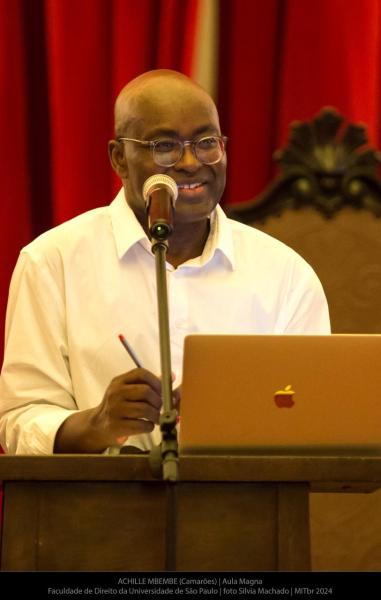
Mbembe in São Paulo

Prof. Mbembe's first time in São Paulo. This event formed part of the São Paulo International Theater Show.

@Universidade de São Paulo

Images by: Silvia Machado


"‘Sou pessimista sobre um futuro sem racismo’, diz Mbembe"

Em entrevista a VEJA, Achille Mbembe falou sobre filosofia africana, fragilidades da democracia contemporânea e construção de uma sociedade mais sustentável

[Translation] In an interview with VEJA, Achille Mbembe talked about African philosophy, the fragilities of contemporary democracy, and the construction of a more sustainable society.

More on @Veja - By Luiz Paulo Souza 

Achille Mbembe: Thinking the World from Africa

In collaboration with the Holberg Prize, Centre for Women’s and Gender Research (SKOK) and the Research Group for Radical Philosophy and Literature invite you all to an open seminar/reading session on this year’s Holberg Prize winner: historian, political theorist and public intellectual Achille Mbembe.

Liberated Africans and the abolition of debt imprisonment in the Gambia colony under the British West African Settlements,1866--1888

Presented by: 
Lamin
Manneh
In 1873, the Gambia colony became the first British West African colony to abolish debt imprisonment. The Gambia colony by abolishing debt imprisonment became part of a larger wave of mid-19th century advancements in progressive debtor reforms happening across the British Empire.

Divinatory Computation : Artificial Intelligence and Africa

Faeeza Ballim & Keith Breckenridge, 24 October 2018

p { margin-bottom: 0.25cm; direction: ltr; line-height: 115%; text-align: left; }p.western { font-size: 12pt; }p.cjk { font-size: 12pt; }p.ctl { font-size: 12pt; } According to Google’s global search trends, South Africans are strangely obsessed by the fourth industrial revolution.

Bhalisa 6 | The politics of Intermediation in the building of digital identification systems | Temple Campus Rome, July 13 - 4, 2026

The 6th Meeting of the Bhalisa Network

Temple Rome, July 13 and 14, 2026

The politics of Intermediation in the building of digital identification systems

Hosted by Temple Law with support from DigID and WISER.

Draft Programme is available here.

Intertwined vines: Homophily among French Huguenots in eighteenth-century Cape Colony

Presented by: 
Christie
Swanepoel
Homophily refers to the observation in networks that more connections are formed between nodes who share a similar background characteristic.