
Avian Encounters: Bird/Human Relations Session with James Webb | October 19, 4-5pm SAST
You are warmly invited to the eleventh session in a new seminar series on Monday, 19 October 4-5pm SAST
Avian Encounters: Bird/Human Relations
Convened by Isabel Hofmeyr and Sarah Nuttall
There’s No Place Called Home: Hacking the Familiar
Presented by : James Webb
Please watch video here (Password:
Zoom link here
This will be an illustrated talk and listening session related to James Webb’s ongoing project There’s No Place Called Home, followed by a discussion. First made in 2004, the work consists of birdsong broadcast from concealed speakers in locations where that species of bird would not ordinarily be found. Since then, it has been remade over 60 times in different locations around the world. Using images, audio examples, and documentation from different versions of the work, the talk will introduce the project’s development, its form, and some of the questions it raises around sound, site, and attention.
James Webb was born in Kimberley, South Africa, and is based in Sweden. He works with sound, text, installation, and found materials. To date, he has had solo exhibitions at the Art Institute of Chicago, USA; Liljevalchs Konsthall, Sweden; Hordaland Kunstsenter and Kunsthuset Kabuso, both Norway; mac Birmingham, UK; and the Johannesburg Art Gallery, South Africa. Selected group exhibitions include the 8th and 16th Biennale de Lyon, 13th Dakar Biennale, 13th Sharjah Biennial, 12th Havana Biennial, Prospect.4 New Orleans, and the 55th Venice Biennale, among others.
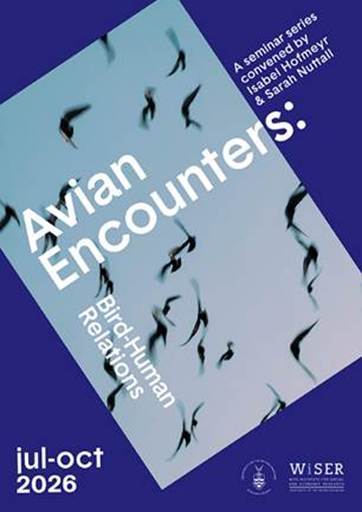
In an age of extinction, partial adaption and survival, what would a better understanding of the lives of birds afford us – and perhaps them? Unlike humans, birds travel anywhere, sing in a manner no other animal can and hear sound at distances undetectable to us. They forge or disavow encounters with humans that suggest complex relationalities. How to bridge the bird/human divide, drawing on the strengths of the humanities? Birds have been overfreighted with human meaning: as messengers of the gods, harbingers of the seasons, symbols of captivity and freedom, portentous flocks – not to mention the perspectives of the hunter, the cook, the meat-eater, the pet-owner, the ornithologist, the farmer, the birder. Yet, are there more flight-enabled perspectives* that shift us away those above? What is the birdness of birds - and how are they seen to embody their own lives? What might a history of the grey parrot tell us – about parrots and about us? What do art works using bird acoustics reveal? How do birds redefine geographies of air, water and land? What can film and other media learn from avian perceptual worlds and modes of seeing and looking? How are bird migrations changing with climate change? This series approaches these and other avian-inflected questions with a particular interest in African and Indian-Ocean oriented archives and hemispheric media drawn from literature, science studies, climate sciences, migration studies, and visual and film studies.
*With thanks to Olga Petri and Michael Guida (Winged Worlds Common Spaces of Avian-Human Lives, 2023) for this phrase
Avian Encounters: Bird/Human Relations follows three previous highly subscribed Series, Heated Conversations; Breathing In: Air and Atmospheres; and Plant Lives: Critical Plant Humanities from the global South, convened by Isabel Hofmeyr and Sarah Nuttall