
Avian Encounters: Bird/Human Relations Session with Chevonne Reynolds, Koi Pillay and Matt Noakes | October 12, 4-5pm SAST
You are warmly invited to the tenth session in our widely subscribed seminar series on Monday 12 October 4-5pm SAST
Avian Encounters: Bird/Human Relations
Convened by Isabel Hofmeyr and Sarah Nuttall
Life on the Wing: Avian Migrations, Persecutions and the Challenges of Climate Change
This session takes the form of a panel with three speakers.
Zoom link here
Chevonne Reynolds will discuss how bird migration is usually imagined as a single, predictable seasonal journey, but movement in birds takes many forms. This talk introduces some of that variety, from classic long-distance migration to the more irregular, nomadic movements that track unpredictable water and food across the Afrotropics. Much about where African birds actually go still remains largely unknown, yet what is clear is that these extreme flyers depend on intact habitat and connected landscapes across vast distances, which makes protecting those networks essential to their survival. The movement ecology of Africa's birds is a fascinating and newly emerging topic, which highlights some important gaps in how we characterise and understand migration. Koi Pillay will speak on how predators are frequently at the centre of human-wildlife conflicts which threaten biodiversity and ecosystem stability. Birds of prey (also known as raptors, and including eagles, hawks, vultures and owls) are widespread predatory birds. Raptors are crucial to the ecosystem, have important cultural value and are indicators for environmental health – but are more threatened than almost all bird groups, with human-raptor conflict as one of the many drivers of this decline. This conflict will be at the centre of my short talk – as well as how research in this area is changing and developing. Matt Noakes will discuss how birds maintain high metabolic rates and body temperatures for flight, leading to high internal heat loads. This is a particular challenge in hot environments, as birds must avoid overheating via physiological and behavioural responses. In this talk, I will discuss how birds are affected by climate change, including their risk during heat waves and how we expect them to respond as temperatures continue to rise.
Readings :
Chevonne Reynolds is an ornithologist at the University of the Witwatersrand, where her research focuses on birds and environmental change. She is particularly interested in animal movement and how it can be used to understand the health and resilience of ecosystems. She is an avid birder and author of 300-easy-to-see-birds-in-
Koi Pillay is a PhD candidate at the University of Cape Town working at the FitzPatrick Institute of African Ornithology. From a young age he knew that he was going to pursue biology, and specifically ornithology. His love for birds led him to where he is now and he hopes that his research is able to help not just birds but also people.
Matt Noakes is an ecophysiologist whose research focuses on the thermoregulation of birds and small mammals. He has worked in environments ranging from the deserts of southern Africa to temperate forests in Europe and Canada, and is now based in the School of Animal, Plant and Environmental Sciences at Wits University. He studies responses ranging from cold endurance to heat tolerance, as well as how individuals balance energy and water budgets. He is particularly interested in the ability of animals to adapt to rapid environmental changes, such as those occurring due to climate change.
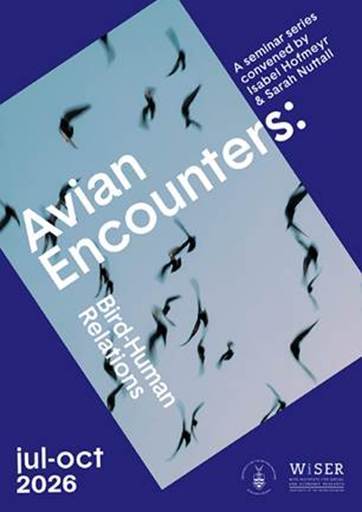
In an age of extinction, partial adaption and survival, what would a better understanding of the lives of birds afford us – and perhaps them? Unlike humans, birds travel anywhere, sing in a manner no other animal can and hear sound at distances undetectable to us. They forge or disavow encounters with humans that suggest complex relationalities. How to bridge the bird/human divide, drawing on the strengths of the humanities? Birds have been overfreighted with human meaning: as messengers of the gods, harbingers of the seasons, symbols of captivity and freedom, portentous flocks – not to mention the perspectives of the hunter, the cook, the meat-eater, the pet-owner, the ornithologist, the farmer, the birder. Yet, are there more flight-enabled perspectives* that shift us away those above? What is the birdness of birds - and how are they seen to embody their own lives? What might a history of the grey parrot tell us – about parrots and about us? What do art works using bird acoustics reveal? How do birds redefine geographies of air, water and land? What can film and other media learn from avian perceptual worlds and modes of seeing and looking? How are bird migrations changing with climate change? This series approaches these and other avian-inflected questions with a particular interest in African and Indian-Ocean oriented archives and hemispheric media drawn from literature, science studies, climate sciences, migration studies, and visual and film studies.
*With thanks to Olga Petri and Michael Guida (Winged Worlds Common Spaces of Avian-Human Lives, 2023) for this phrase
Avian Encounters: Bird/Human Relations follows three previous highly subscribed Series, Heated Conversations; Breathing In: Air and Atmospheres; and Plant Lives: Critical Plant Humanities from the global South, convened by Isabel Hofmeyr and Sarah Nuttall