
INVITE | Avian Encounters: Bird/Human Relations Opening Session with Mia Couto | August 24, 4-5pm SAST
You are warmly invited to the fourth session in a new seminar series on Monday 24 August 4-5pm SAST
Avian Encounters: Bird/Human Relations
Convened by Isabel Hofmeyr and Sarah Nuttall
*Throughout the series, we will table a paper, a set of images or a sound piece a week beforehand. Please be sure to read, look or listen to these in advance in order to make for more engaged and fruitful discussion all round.
Mia Couto In Conversation with Stefan Helgesson
Acclaimed Mozambican writer Mia Couto has long had an interest in avian themes and bird lives appear often in his fiction. The centrality of birds in his thinking is apparent from many of his writerly observations and from his novels and short stories. Couto once noted that ‘wing flaps turn the sky’s transparent pages’. Across his oeuvre, he explores, amongst numerous other examples, what a raven’s ‘dialect’ might sound like, birds that seem to come ‘from the furthest frontier of life’, lightning birds, and a bird-dreaming baobab. Couto was trained as a biologist and has worked extensively in environmental research particularly in Mozambique’s coastal zones. He has said that biology gives him ‘a language to understand (and to share other languages with) apparently different creatures’. (Interview with Will Forrester, Pen Transmissions, Dec 2020). He has also observed that what he searches for in his scientific work ‘is a familiarity with other living creatures that have a different logic and language from ours. I want to become part of their universe and to recover a lost proximity’ (cited in Hamilton and Huddart, 2021).
Click here for the reading
Click here for further reading
In this session and in discussion with literary scholar Stefan Helgesson, Couto will revisit some of his work from an avian angle.
Mia Couto is a celebrated Mozambican writer and an environmental biologist. His novels and short stories focus on the devastation of civil war, cultural and linguistic hybridities and ecological fragility. He is the winner of many prizes for his work, including the prestigious Camões Prize (2013) and the Neustadt International Prize for Literature (2014).
Stefan Helgesson is Professor of English at Stockholm University and a senior research associate at Rhodes University. His scholarly interests include African literature, Brazilian literature, translation theory and world literature methodologies. He is the author of Decolonisations of Literature: Critical Practice in Africa and Brazil after 1945 (2022). Occasionally he translates from Portuguese to Swedish.
Please find zoom link here
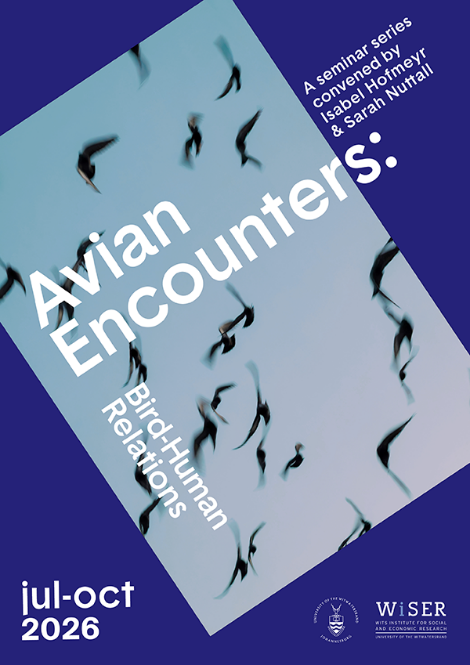
In an age of extinction, partial adaption and survival, what would a better understanding of the lives of birds afford us – and perhaps them? Unlike humans, birds travel anywhere, sing in a manner no other animal can and hear sound at distances undetectable to us. They forge or disavow encounters with humans that suggest complex relationalities. How to bridge the bird/human divide, drawing on the strengths of the humanities? Birds have been overfreighted with human meaning: as messengers of the gods, harbingers of the seasons, symbols of captivity and freedom, portentous flocks – not to mention the perspectives of the hunter, the cook, the meat-eater, the pet-owner, the ornithologist, the farmer, the birder. Yet, are there more flight-enabled perspectives* that shift us away those above? What is the birdness of birds - and how are they seen to embody their own lives? What might a history of the grey parrot tell us – about parrots and about us? What do art works using bird acoustics reveal? How do birds redefine geographies of air, water and land? What can film and other media learn from avian perceptual worlds and modes of seeing and looking? How are bird migrations changing with climate change? This series approaches these and other avian-inflected questions with a particular interest in African and Indian-Ocean oriented archives and hemispheric media drawn from literature, science studies, climate sciences, migration studies, and visual and film studies.
*With thanks to Olga Petri and Michael Guida (Winged Worlds Common Spaces of Avian-Human Lives, 2023) for this phrase
Avian Encounters: Bird/Human Relations follows three previous highly subscribed Series, Heated Conversations; Breathing In: Air and Atmospheres; and Plant Lives: Critical Plant Humanities from the global South, convened by Isabel Hofmeyr and Sarah Nuttall