
The WiSER Podcast | Caio Simoes De Araujo | Bridging the Bay: Maputo-Katembe
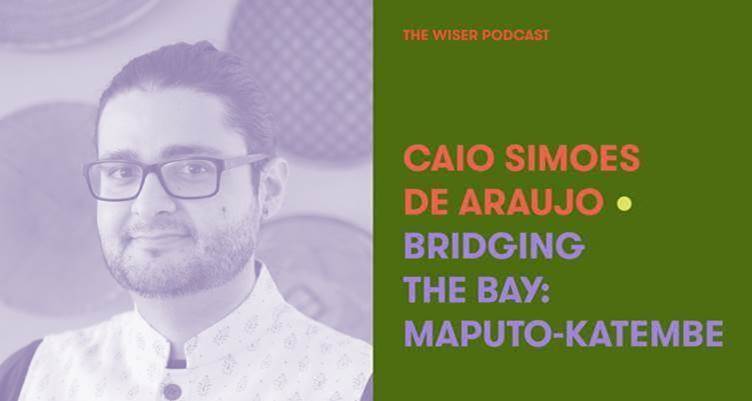
In this episode, Caio Simões de Araújo discusses the politics of infrastructure in Southern Africa, taking as an entry point the Maputo-Katembe bridge, inaugurated in 2018. Araújo argues that the bridge is part of a renewed public investment in infrastructure enabled by Chinese cooperation in Africa. Yet, rather than a straightforward road into the future, the bridge is embedded in a highly complex set of temporal landscapes - ones that warrant close and careful analysis.
Caio Simoes De Araujo is a post-doctoral researcher in the Regions2050 programme at WiSER. He is the editor of A Luta Continua, 40 anos depois: Histórias Entrelaçadas da África Austral (Alcance, 2017). Related to this podcast is a short experimental film "The bridge", which is about the inauguration of the bridge back in 2018. The film is included in the online exhibition, Archive of Forgetfulness: https://archiveofforgetfulness.com
Podcasts
Podcast of Living Together/Living Apart: A Collaboration between Neo Muyanga and Khadija Patel
A podcast of Neo Muyanga and Khadija Patel's recent seminar Living Together/Living Apart: The Complexity of Home'.
Curating the Afropolitan City
During the last decades of the 20th century, a significant body of work has thrown into doubt the concept of “the city” as a universal object or category of analysis as well as traditional approaches to urban development and human settlements. This reappraisal has been caused partly by the emergence, in the global South, of megacities and mega-regions whose density, massive spatial expansion, sheer scale of population, high levels of risk and great wealth disparities have been accompanied by dynamic and unexpected modes of urban growth. Such is the case of Johannesburg. The latter has continued to expand in a relatively uncontrolled, decentralized if not random way. Today the city is better understood as a largely de-territorialized mega-region with multiple urban enclaves. Its myriad public spaces are increasingly privatized. Novel patterns of trans-regional migration, settlement and high consumption are transforming its economic and cultural fabric, paving the way for the emergence of highly stylized, hybrid, creolized forms. Visible and invisible networks of social and economic exchange participate in, but are also separate from the mainstream flows of global capital, real and fictitious. One of its defining features is not only its disjunctive social geography, but also the way in which humans and non-humans are linked together in heterogeneous and often unrecognized assemblages (electricity, food, air, energy, water) that contribute to the making of a unique urban form. More than at any other point in its history, this mega-region is the direct outcome of a new nexus of nature, culture and finance as well as a different politics of human/non-human/techno-ecological relations. Using concepts and methods borrowed from design and aesthetic theory, architecture, digital mapping and curation, this Platform will initiate a cycle of new historical and ethnographic studies of Johannesburg. It will bring together scholars, writers, artists, architects, photographers, designers and planners. Building on Walter Benjamin model of the Arcades Project, it will explore the relationship between contemporary urban forms on the one hand, and on the other, the complex technological networks and the organic, geological and biospheric metabolisms that shape them.