
INVITE | Avian Encounters: Bird/Human Relations Third Session with Vulindlela Nyoni | Aug 17, 4-5pm SAST
You are warmly invited to the third session in a new seminar series on Monday 17 August 4-5pm SAST
Avian Encounters: Bird/Human Relations
Convened by Isabel Hofmeyr and Sarah Nuttall
*Throughout the series, we will table a paper, a set of images or a sound piece a week beforehand. Please be sure to read, look or listen to these in advance in order to make for more engaged and fruitful discussion all round.
Bird-Brained: Diasporic and Migratory Subjectivities through the Mind and Eyes of a Printmaker
Presented by : Vulindlela Nyoni
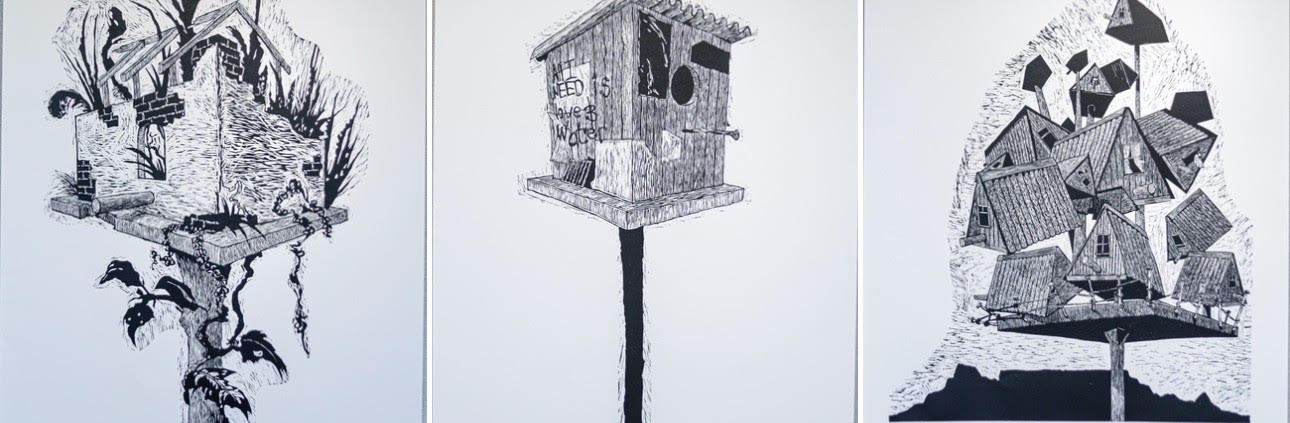
"Domicilium citandi et executandi" Linocut 2025 (ed5);"All I need is Love and Water" Linocut 2025 (ed5)"Endabeni" Linocut 2021 (ed5), 2025 (2nd ed5) (100cm x70cm)
Birds have long occupied a central place in my personal, intellectual and creative inquiry. As both symbolic and material presences, they provide a lexicon through which I examine fundamental questions concerning humanity, human migratory behaviour, and my relationship with my place in the world. This seminar explores the diverse ways in which birds have informed my creative practice as a migrant to South Africa from Zimbabwe, both thematically and iconographically. More significantly, it considers how avian life serves as a philosophical lens through which I interrogate human identity, self-understanding, and the assumptions that shape our sense of belonging and home. By reflecting on the role of birds in a number of works, specifically Murmurations 2014, my ongoing 'Icarus' series and bird-houses, I examine their capacity to illuminate broader questions about how we relate to one another, our individual agency in relation to mechanisms of membership belonging, and the boundaries between us all.
Prof Vulindlela Nyoni is an Associate Professor in printmaking at the Department of Visual Arts, Nelson Mandela University. His doctoral thesis was entitled “Diaspora in Dialogue: An Ontology of Diasporic Subjectivity in the work of three artists living in-between South Africa and Zimbabwe". His most recent solo exhibition was entitled "(un)favourable conditions" and was held at the GFI gallery in 2025.
In an age of extinction, partial adaption and survival, what would a better understanding of the lives of birds afford us – and perhaps them? Unlike humans, birds travel anywhere, sing in a manner no other animal can and hear sound at distances undetectable to us. They forge or disavow encounters with humans that suggest complex relationalities. How to bridge the bird/human divide, drawing on the strengths of the humanities? Birds have been overfreighted with human meaning: as messengers of the gods, harbingers of the seasons, symbols of captivity and freedom, portentous flocks – not to mention the perspectives of the hunter, the cook, the meat-eater, the pet-owner, the ornithologist, the farmer, the birder. Yet, are there more flight-enabled perspectives* that shift us away those above? What is the birdness of birds - and how are they seen to embody their own lives? What might a history of the grey parrot tell us – about parrots and about us? What do art works using bird acoustics reveal? How do birds redefine geographies of air, water and land? What can film and other media learn from avian perceptual worlds and modes of seeing and looking? How are bird migrations changing with climate change? This series approaches these and other avian-inflected questions with a particular interest in African and Indian-Ocean oriented archives and hemispheric media drawn from literature, science studies, climate sciences, migration studies, and visual and film studies.
*With thanks to Olga Petri and Michael Guida (Winged Worlds Common Spaces of Avian-Human Lives, 2023) for this phrase
Please find zoom link here
Avian Encounters: Bird/Human Relations follows three previous highly subscribed Series, Heated Conversations; Breathing In: Air and Atmospheres; and Plant Lives: Critical Plant Humanities from the global South, convened by Isabel Hofmeyr and Sarah Nuttall