
INVITE | Avian Encounters: Bird/Human Relations Session with Madhumita Lahiri | August 31, 4-5pm SAST
You are warmly invited to the fifth session in a new seminar series on Monday 31 August 4-5pm SAST
Avian Encounters: Bird/Human Relations
Convened by Isabel Hofmeyr and Sarah Nuttall
*Throughout the series, we will table a paper, a set of images or a sound piece a week beforehand. Please be sure to read, look or listen to these in advance in order to make for more engaged and fruitful discussion all round.
Presented by : Madhumita Lahiri
Click here for paper
We recommend participants watch All that Breathes before the session (available on a range of streaming services)
Please find zoom link here
This talk examines the role of synanthropic bird species –that is, bird species which thrive in human environments – in globally successful Indian cinema. I focus on the acclaimed 2022 film All That Breathes (dir. Shaunak Sen), which won a battery of film festival prizes as well as widespread international distribution. Celebrated for its innovations in the genre of nature documentary, All That Breathes centers on two brothers in India who feed and rehabilitate black kites. At a formal level, All That Breathes uses a remarkably slow tempo and an uncanny soundtrack, developing a cinematography of bird portraits, gazes, and reflections. Withholding the more familiar conventions of bird photography, such as stunning close-ups of flying birds of prey, the film never leaves the ground. Instead, through long takes that slowly shift perspective and focus, the film highlights the elaborate species interdependence of India’s capital city as well as its ongoing ecological catastrophe. We see birds’ eyes viewing; we do not see bird’s-eye views. I focus on All That Breathes’ repeated scenes of bird-feeding, juxtaposing them with the iconic bird-feeding scenes in the iconic Bollywood film Dilwale Dulhania Le Jayenge (DDLJ, 1995). Definitive of the globalized Indian cinema of its moment, DDLJ famously opened with a scene of pigeon-feeding in England. I ask what the shifting depiction of familiar urban birds, such as kites and pigeons, tells us about Indian filmmaking over the last several decades. Amongst other questions, I ask: what do films about birds show us when they explicitly refuse the bird’s eye view, choosing to highlight bird-feeding instead?
Madhumita Lahiri is the author of Imperfect Solidarities: Tagore, Gandhi, Du Bois, and the Global Anglophone and an Associate Professor of English at the University of Michigan, Ann Arbor (USA). She researches the stories that large multiethnic democracies – such as India, South Africa, and the United States – tell themselves about identity, community, and social change. Educated in India and the US, she previously held research and teaching positions at the University of the Witwatersrand (South Africa) and the University of Warwick (United Kingdom). Her work has appeared most recently in the Michigan Quarterly Review.
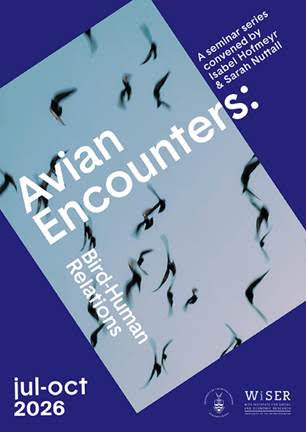
In an age of extinction, partial adaption and survival, what would a better understanding of the lives of birds afford us – and perhaps them? Unlike humans, birds travel anywhere, sing in a manner no other animal can and hear sound at distances undetectable to us. They forge or disavow encounters with humans that suggest complex relationalities. How to bridge the bird/human divide, drawing on the strengths of the humanities? Birds have been overfreighted with human meaning: as messengers of the gods, harbingers of the seasons, symbols of captivity and freedom, portentous flocks – not to mention the perspectives of the hunter, the cook, the meat-eater, the pet-owner, the ornithologist, the farmer, the birder. Yet, are there more flight-enabled perspectives* that shift us away those above? What is the birdness of birds - and how are they seen to embody their own lives? What might a history of the grey parrot tell us – about parrots and about us? What do art works using bird acoustics reveal? How do birds redefine geographies of air, water and land? What can film and other media learn from avian perceptual worlds and modes of seeing and looking? How are bird migrations changing with climate change? This series approaches these and other avian-inflected questions with a particular interest in African and Indian-Ocean oriented archives and hemispheric media drawn from literature, science studies, climate sciences, migration studies, and visual and film studies.
*With thanks to Olga Petri and Michael Guida (Winged Worlds Common Spaces of Avian-Human Lives, 2023) for this phrase
Avian Encounters: Bird/Human Relations follows three previous highly subscribed Series, Heated Conversations; Breathing In: Air and Atmospheres; and Plant Lives: Critical Plant Humanities from the global South, convened by Isabel Hofmeyr and Sarah Nuttall