
INVITE | Avian Encounters: Bird/Human Relations Opening Session with Nancy Jacobs | July 27, 4-5pm SAST
You are warmly invited to the first session in a new seminar series on Monday 27 July 4-5pm SAST
Avian Encounters: Bird/Human Relations
Convened by Isabel Hofmeyr and Sarah Nuttall
*Throughout the series, we will table a paper, a set of images or a sound piece a week beforehand. Please be sure to read, look or listen to these in advance in order to make for more engaged and fruitful discussion all round.
The Global Grey Parrot: How a Charismatic African Animal Became an International Commodity
Presented by : Nancy Jacobs
Click here for paper
This is the introduction to a book that tells the history of the transformation of character-filled animals from wild creatures to captive companions, global commodities, and protected species. This book draws on fieldwork in Africa, historical documents, and visual records to present a five-century-long history that moves from precolonial societies to early modern menageries, natural history, hobbyist bird keeping, trapping enterprises, industrial breeding, cognitive ethology, and conservation policy. Bridging environmental history, economic history, and more-than-human studies, The Global Grey Parrot argues that grey parrots’ commodification was a material process shaped by the character of grey parrots, African political economies, and their uneven incorporation into global capitalism—linking the intimate captivity of animals to histories of extraction, labor, and unequal exchange.
Nancy Jacobs is a Professor in the History Department of Brown University, where she teaches courses on South African history, colonial African history, animal history and environmental history. Her books Environment, Power and Injustice: A South African History (Cambridge University Press 2003), African History through Sources: Colonial Contexts and Everyday Experiences, c. 1850–1946 (Cambridge University Press 2014), Birders of Africa: History of a Network (Yale University Press 2016) and The Global Grey Parrot: How a Charismatic African Animal Became an International Commodity (University of Washington Press 2027) all show how overlooked, every day, and dismissed actors actually were making worlds all along.
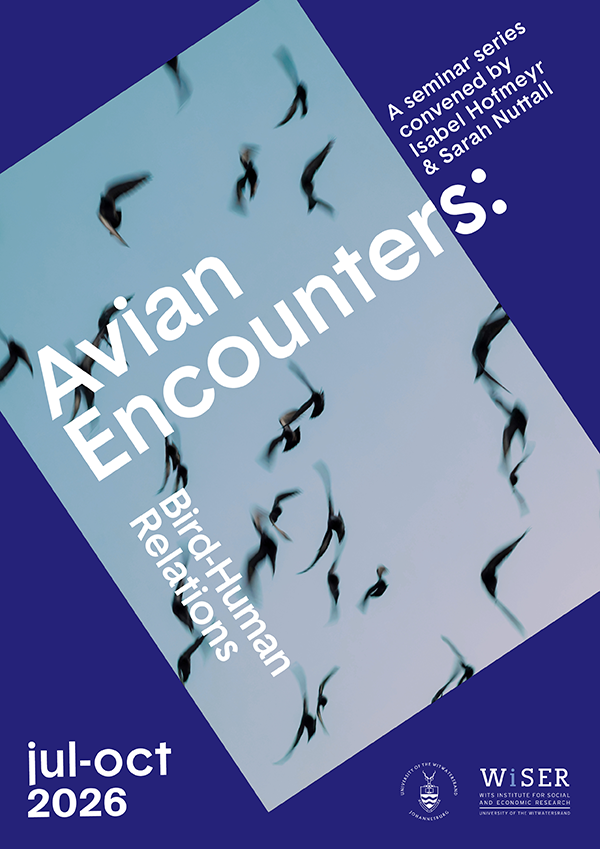 In an age of extinction, partial adaption and survival, what would a better understanding of the lives of birds afford us – and perhaps them? Unlike humans, birds travel anywhere, sing in a manner no other animal can and hear sound at distances undetectable to us. They forge or disavow encounters with humans that suggest complex relationalities. How to bridge the bird/human divide, drawing on the strengths of the humanities? Birds have been overfreighted with human meaning: as messengers of the gods, harbingers of the seasons, symbols of captivity and freedom, portentous flocks – not to mention the perspectives of the hunter, the cook, the meat-eater, the pet-owner, the ornithologist, the farmer, the birder. Yet, are there more flight-enabled perspectives* that shift us away those above? What is the birdness of birds - and how are they seen to embody their own lives? What might a history of the grey parrot tell us – about parrots and about us? What do art works using bird acoustics reveal? How do birds redefine geographies of air, water and land? What can film and other media learn from avian perceptual worlds and modes of seeing and looking? How are bird migrations changing with climate change? This series approaches these and other avian-inflected questions with a particular interest in African and Indian-Ocean oriented archives and hemispheric media drawn from literature, science studies, climate sciences, migration studies, and visual and film studies.
*With thanks to Olga Petri and Michael Guida (Winged Worlds Common Spaces of Avian-Human Lives, 2023) for this phrase
Please find zoom link here
Avian Encounters: Bird/Human Relations follows three previous highly subscribed Series, Heated Conversations; Breathing In: Air and Atmospheres; and Plant Lives: Critical Plant Humanities from the global South, convened by Isabel Hofmeyr and Sarah Nuttall