
Avian Encounters: Bird/Human Relations Session with Tinashe Mushakavanhu | September 28, 4-5pm SAST
You are warmly invited to the eighth session in a new seminar series on Monday 28 September 4-5pm SAST
Avian Encounters: Bird/Human Relations
Convened by Isabel Hofmeyr and Sarah Nuttall
Excavating Birds
Presented by : Tinashe Mushakavanhu
Please find Paper here and Zoom link here
Most bird stories begin in the air. Yvonne Vera's birds begin underground. They come to us through the earth. In her last unpublished novel, Obedience, a miner excavates more than one hundred soapstone birds from the soils of Great Zimbabwe. The birds emerge upright and intact, as though newly hatched after a thousand years of incubation. The scene unsettles many assumptions about birds and birdness itself. These birds do not migrate. They do not sing. They do not fly. They are buried sculptural forms and occupy a strange threshold between earth and sky, archaeology and ornithology, materiality and imagination. What can these buried birds tell us about avian life, memory, survival, and the Zimbabwean imagination? In Yvonne Vera's novel they emerge from the earth; in the performance art of Sethembile Msezane they return to the air. Across these works, the birds move between earth, underground, sky and ancestral realm. They do not offer an elevated view over territory. Their movement is relational rather than sovereign. As they remain partially unknowable, these birds exceed the classificatory ambitions of both the archaeological record and the colonial archive. In attending to them, I ask whether the archaeology of birds might offer a different way of thinking about the bird/human divide, history, and the imaginative work of survival.
Tinashe Mushakavanhu is an Assistant Professor in African & African American Studies at Harvard University. He was educated in Southern Africa and Europe. He was previously a Visiting Assistant Professor at New York University, a postdoctoral fellow at WiSER, and a Junior Research Fellow at the University of Oxford. And he has been twice a judge for the Oxford-Weidenfeld Prize for Translation. At the heart of his research is a commitment to rethinking African literature through the archive in its multimodal forms. His forthcoming book, Here, History Is Not Something Outside (Ugly Duckling Presse), is an experimental archival work that explores the possibilities of literary history, memory, and form.
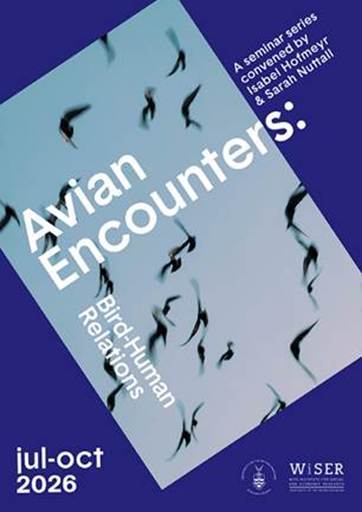
In an age of extinction, partial adaption and survival, what would a better understanding of the lives of birds afford us – and perhaps them? Unlike humans, birds travel anywhere, sing in a manner no other animal can and hear sound at distances undetectable to us. They forge or disavow encounters with humans that suggest complex relationalities. How to bridge the bird/human divide, drawing on the strengths of the humanities? Birds have been overfreighted with human meaning: as messengers of the gods, harbingers of the seasons, symbols of captivity and freedom, portentous flocks – not to mention the perspectives of the hunter, the cook, the meat-eater, the pet-owner, the ornithologist, the farmer, the birder. Yet, are there more flight-enabled perspectives* that shift us away those above? What is the birdness of birds - and how are they seen to embody their own lives? What might a history of the grey parrot tell us – about parrots and about us? What do art works using bird acoustics reveal? How do birds redefine geographies of air, water and land? What can film and other media learn from avian perceptual worlds and modes of seeing and looking? How are bird migrations changing with climate change? This series approaches these and other avian-inflected questions with a particular interest in African and Indian-Ocean oriented archives and hemispheric media drawn from literature, science studies, climate sciences, migration studies, and visual and film studies.
*With thanks to Olga Petri and Michael Guida (Winged Worlds Common Spaces of Avian-Human Lives, 2023) for this phrase
Avian Encounters: Bird/Human Relations follows three previous highly subscribed Series, Heated Conversations; Breathing In: Air and Atmospheres; and Plant Lives: Critical Plant Humanities from the global South, convened by Isabel Hofmeyr and Sarah Nuttall