
Avian Encounters: Bird/Human Relations Second Session with William Kentridge | 3 Aug | 4-5pm SAST
You are warmly invited to the second session in a new seminar series on Monday, 3rd August 4-5pm SAST
Avian Encounters: Bird/Human Relations
Convened by Isabel Hofmeyr and Sarah Nuttall
*Throughout the series, we will table a paper, a set of images or a sound piece a week beforehand. Please be sure to read, look or listen to these in advance in order to make for more engaged and fruitful discussion all round.
William Kentridge in conversation with Isabel Hofmeyr and Sarah Nuttall on avian aspects across his work
Click here to view film ‘Other Faces’ (2011)
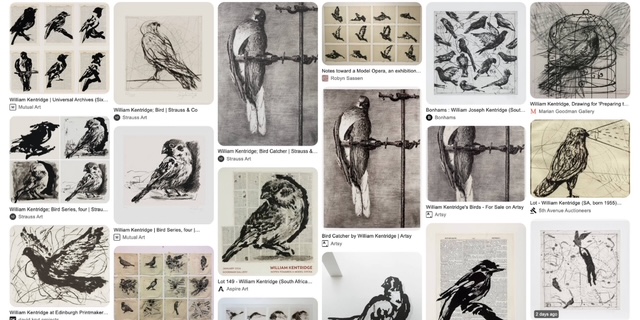
Renowned South African artist William Kentridge has long considered birds across many media and in different forms. These range from his use of the ubiquitous Johannesburg bird the hadeda in his brilliant short film Other Faces to birds in the Magic Flute. Across his corpus, birds themselves become Kentridge-style media: the charcoal blur of flight across a page or screen; birds in the periphery of vision, a brief glimpse from the sideline opening up new contingencies rather than pre-given ideas. His interest in flight and flipbooks recall early chrono-photography which captured regular images of a moving object. This series seeks to open up such flight-enabled perspectives for which Kentridge’s work leads the way. William Kentridge will make some opening remarks on and show some bird-work, followed by a discussion with series conveners Isabel Hofmeyr and Sarah Nuttall.
William Kentridge’s work spans drawing, film, sculpture, theatre, and opera, united by a fluid approach across media. At the core of his practice lies drawing, which he has described as a way of thinking in time—marked by erasure, movement, and revision. Growing up in Johannesburg during apartheid, in what he has called a “fractured society,” Kentridge’s work emerges from a condition of historical rupture and ethical unease. Rather than offering positions or solutions, it proceeds through uncertainty, contradiction, and provisional meaning, often articulated through irony and a dry, self-questioning humour.
Please find Zoom link here
In an age of extinction, partial adaption and survival, what would a better understanding of the lives of birds afford us – and perhaps them? Unlike humans, birds travel anywhere, sing in a manner no other animal can and hear sound at distances undetectable to us. They forge or disavow encounters with humans that suggest complex relationalities. How to bridge the bird/human divide, drawing on the strengths of the humanities? Birds have been overfreighted with human meaning: as messengers of the gods, harbingers of the seasons, symbols of captivity and freedom, portentous flocks – not to mention the perspectives of the hunter, the cook, the meat-eater, the pet-owner, the ornithologist, the farmer, the birder. Yet, are there more flight-enabled perspectives* that shift us away those above? What is the birdness of birds - and how are they seen to embody their own lives? What might a history of the grey parrot tell us – about parrots and about us? What do art works using bird acoustics reveal? How do birds redefine geographies of air, water and land? What can film and other media learn from avian perceptual worlds and modes of seeing and looking? How are bird migrations changing with climate change? This series approaches these and other avian-inflected questions with a particular interest in African and Indian-Ocean oriented archives and hemispheric media drawn from literature, science studies, climate sciences, migration studies, and visual and film studies.
*With thanks to Olga Petri and Michael Guida (Winged Worlds Common Spaces of Avian-Human Lives, 2023) for this phrase
Avian Encounters: Bird/Human Relations follows three previous highly subscribed Series, Heated Conversations; Breathing In: Air and Atmospheres; and Plant Lives: Critical Plant Humanities from the global South, convened by Isabel Hofmeyr and Sarah Nuttall