
Avian Encounters: Bird/Human Relations | Final Session with Gabeba Baderoon and Yvette Christiansë | October 26, 4-5pm SAST
You are warmly invited to the final session in our widely subscribed seminar series on Monday 26 October 4-5pm SAST
Avian Encounters: Bird/Human Relations
Convened by Isabel Hofmeyr and Sarah Nuttall
Hollow Bones: The Unmetaphorical Strangeness of Birds
Presented by : Gabeba Baderoon and Yvette Christiansë
Link to Poems here and Zoom link here
In this closing session of the Avian Encounters series, acclaimed poet-scholars Gabeba Baderoon and Yvette Christiansë lead a conversation, in discussion with the two conveners of the series, Isabel Hofmeyr and Sarah Nuttall, on a selection of poems on avian themes and figurations - some written by the poets themselves. The discussion, guided by the poetry itself, will both round out and return to several significant themes of the Series at large.
Gabeba Baderoon is the author of the poetry collections, The Dream in the Next Body, A hundred silences and The History of Intimacy, and chairs the board of New Contrast journal. She has held writing fellowships at the University of Cape Town, the Harvard Radcliffe Institute and the Stellenbosch Institute for Advanced Study and received an Honorary Doctorate from Nelson Mandela University. She is at work on a verse memoir of concussion, "Autobiography of Sand: Relief Map of a Drifting Mind.”
Yvette Christiansë is the author of the poetry collections Castaway (1999) and Imprendehora (2009), as well as a novel Unconfessed (2007). Imprendehora was a finalist for the Via Afrika Herman Charles Bosman Prize in 2010 and Castaway was a finalist in the 2001 PEN International Poetry Prize. Her novel Unconfessed was a finalist for the Hemingway/PEN Prize for first fiction and received a 2007 ForeWord Magazine BEA Award. It was also shortlisted for the University of Johannesburg Prize and the International IMPAC Dublin Literary Award in 2008, and nominated for the Ama Ata Aidoo Prize 2010. Her poetry has been published in the U.S., South Africa, Australia, Canada, France and Italy. She is also the recipient of The Harri Jones Memorial Prize for poetry (Australia). Yvette is Professor of Africana Studies and English Literature at Barnard College.
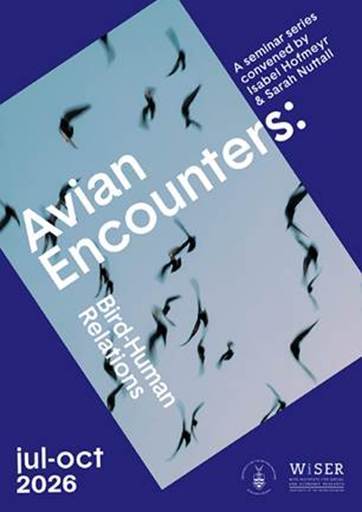
In an age of extinction, partial adaption and survival, what would a better understanding of the lives of birds afford us – and perhaps them? Unlike humans, birds travel anywhere, sing in a manner no other animal can and hear sound at distances undetectable to us. They forge or disavow encounters with humans that suggest complex relationalities. How to bridge the bird/human divide, drawing on the strengths of the humanities? Birds have been overfreighted with human meaning: as messengers of the gods, harbingers of the seasons, symbols of captivity and freedom, portentous flocks – not to mention the perspectives of the hunter, the cook, the meat-eater, the pet-owner, the ornithologist, the farmer, the birder. Yet, are there more flight-enabled perspectives* that shift us away those above? What is the birdness of birds - and how are they seen to embody their own lives? What might a history of the grey parrot tell us – about parrots and about us? What do art works using bird acoustics reveal? How do birds redefine geographies of air, water and land? What can film and other media learn from avian perceptual worlds and modes of seeing and looking? How are bird migrations changing with climate change? This series approaches these and other avian-inflected questions with a particular interest in African and Indian-Ocean oriented archives and hemispheric media drawn from literature, science studies, climate sciences, migration studies, and visual and film studies.
*With thanks to Olga Petri and Michael Guida (Winged Worlds Common Spaces of Avian-Human Lives, 2023) for this phrase
Avian Encounters: Bird/Human Relations follows three previous highly subscribed Series, Heated Conversations; Breathing In: Air and Atmospheres; and Plant Lives: Critical Plant Humanities from the global South, convened by Isabel Hofmeyr and Sarah Nuttall